Saturday, April 9, 2016

Author Interview: Dane Cobain, Author of No Rest for the Wicked

Dane Cobain is a writer, poet and musician from a place you've probably never heard of, somewhere in England. When he's not writing books, he's reading and reviewing them on his book blog - SocialBookshelves.com - or working at his day job in social media marketing. Find him at Facebook.com/DaneCobainMusic or follow @DaneCobain on Twitter.
No Rest for the Wicked
When the Angels attack, there’s NO REST FOR THE WICKED.
Father Montgomery, an elderly priest with a secret past, begins to investigate after his parishioners come under attack, and with the help of Jones, a young businessman with an estranged child, Montgomery begins to track down the origin of the Angels.
The Angels are naked and androgynous. They speak in a dreadful harmony with no clear leader. These aren’t biblical cherubs tasked with the protection of the righteous – these are deadly creatures of light that have the power to completely eradicate.
When Jones himself is attacked, Father Montgomery knows he has to act fast. He speaks to the Angels and organises a final showdown where he’s asked to make the ultimate sacrifice.

Who are your influences?
I have a bunch of different influences, depending upon the type of writing that I’m doing. Some of the key writers to have influenced me over the years include Graham Greene, Ernest Hemingway, Charles Bukowski, Terry Pratchett and Philip Pullman.

When did you begin writing?
I’ve been writing seriously since I was about sixteen, but I used to dabble with it here and there way before then. I wrote a novel before I was eighteen, and then went to university to study creative writing. I guess that was when I started to take it seriously.

How do you come up with your stories, characters, character names, POV, etc?
It’s hard to tell, really. I usually start with a simple idea and then develop and refine it over time. No Rest for the Wicked, my supernatural thriller, grew out of a nightmare that I had.

Do you work from an outline?
Yeah – I develop the initial idea as much as I can and then create a full plot outline with as much detail as I can manage. With that in hand, I start work on the full story.

Tell me about your favorite scene in your novel.
There were quite a few scenes that stand out, each one for different reasons. My overall favourite scenes were probably the ones that dealt with the flashbacks into Montgomery’s past – you got to know him a lot more, and he was an interesting character with complex motivations. At least, I hope he was.

Can you tell us a little about your writing philosophy?
I just like to read a lot and to write a lot, and to get as much done as possible. Even if you never get round to using a first draft, it’s better than having no first draft at all. Being a writer is hard work, but it’s also infinitely rewarding. You need to appreciate that before you get sucked into it, or you’ll never be successful.

Have you ever tried writing in any other genres?
I write in all sorts of different genres – my first book was a supernatural thriller, and my second book was a book of poetry. Up next, I have another novel, followed by a non-fiction book, followed by a screenplay and accompanying novella. Then I’m going to work on a detective series. It’s all go!

Friday, February 26, 2016

Guest Post: Minor Characters by Jerold Last

Jerold Last is a Professor of Pulmonary and Critical Care Medicine at the University of California's Medical School at Davis, near Sacramento in Northern California.  Jerry, a two-time winner of The Indie Book of the Day Award, writes “tweener” mystery books (tough mystery stories that follow the cozy conventions of no graphic sex and no cussing) that are fast moving and entertain the reader.  Several of the books introduce the readers to South America, a region where he has lived and worked that is a long way from home for most English speakers.  He and his wife Elaine lived previously in Salta, Argentina and Montevideo, Uruguay.  Jerry selects the most interesting South American locations he found for Roger and Suzanne to visit while solving miscellaneous murders.  Montevideo, Salta, Machu Picchu, the Galapagos Islands, and Iguazu Falls are also characters in these books, and the novels portray these places as vivid and real.  Jerry and Elaine breed prize-winning German shorthaired pointer dogs; Elaine also provides technical advice for Jerry’s dog-related novels like The Deadly Dog Show and Hunter Down, as well as editing for all of the books.
Synopsis of Unbearably Deadly
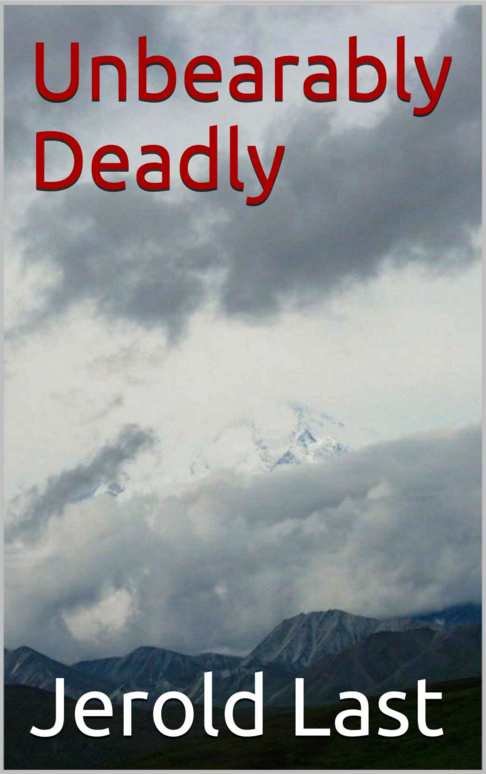
For a change, the butler didn’t do it; a bear did.  Or did it?  In “Unbearably Deadly”, Roger and Suzanne visit Alaska to find out the circumstances surrounding their friends’ deaths.  The FBI investigation concludes the cause of death was a tragic accident.  With nothing more than a gut feeling that something is amiss, our sleuths head to Alaska to search for the truth.  The vast expanse of Denali National Park creates a 6-million acre locked room murder case for our sleuths to solve.  There are no suspects, no clues, and little help available.  Conspiracies abound and the truth is much more complicated than it appears.
Where Do Those Characters in the Books Come From?

As we try to create the imaginary worlds of our books, to be believable we have to rely on reality for inspiration.  I use the places I’ve lived in and visited in South America as settings in my South American Mystery novels.  These novels have to be populated with people, both the central characters like my detectives Roger Bowman and Suzanne Foster, and all of the rest of the people they will meet as they investigate the murder or murders.  We quickly encounter a problem of how to make these other characters into distinct individuals rather than just 20 stereotypes named Pedro or Jose.  To solve this problem I often use real people I’ve met in South America as models for fictional characters in these books.  The process begins by visualizing someone I actually met for a physical description, and/or by taking part of their personas to start building the fictional characters.  To demonstrate the process, let’s follow the path from reality to book pages of several suspects in the murders being investigated in three of my novels. 
      First up is Bernardo Colletti, the head of the Uruguayan Nazi Party from The Ambivalent Corpse, and a suspect in the murder.  He has strong roots in reality.  I first visited Montevideo in 1982 as a Fulbright Professor teaching courses in toxicology and protein biochemistry during the waning days of an ultraconservative military dictatorship.  One of my hosts was married to a physician who worked in the Emergency Room (think of George Clooney’s role in ER) of the major hospital in Montevideo who turned out to be the head of the Uruguayan Nazi Party.  Despite his politics, he was a charming and well-educated (Uruguay and Chicago, USA) physician with whom I was expected to interact professionally and socially while I was there.  To create Bernardo’s character in the book, I merely aged his role model from 1982 to 2011 and grafted the real Nazi’s looks and personality onto the fictional one.  Despite the obvious reasons one should not like a virulent fascist, I tried to portray Bernardo as I recalled the real person: extremely charming and intelligent in social settings where he chose not to emphasize the more odious of his political views.  But, I have to admit, I enjoyed killing him off in The Body In The Bed.
      Next up is another character (actually a couple) from The Ambivalent Corpse, Gerardo and Andrea, who act as hosts for Suzanne at the University de la Republica and become good friends of our heroes as the story evolves.  The couple is modeled after my best friends and scientific colleagues in Montevideo. They are, in fact, named after their two children.  Now there’s a switch, naming the parents after their children.  You can get a real sense of power when you write fiction!  The scene at the Feria (open air market) in the park described in the book is based on the actual Saturday morning Feria in the park across the street from the apartment we rented when we lived in Montevideo.  Andrea’s research with algal toxins she describes at dinner in the book is pretty close to what the real “Andrea and Gerardo” do in Montevideo, and formed a large part of the basis for our collaborative research and teaching. 
In The Surreal Killer, Suzanne and Roger are taken for a flight over Northern Chile’s vast Atacama Desert in a small two-engine plane by two of their suspects, Pedro and Romero.  Along the way, Pedro gives both of them lessons in how to fly the plane.  Pedro’s character is a composite based upon a couple of real scientists I’ve known very well.  One of them is a North American, originally from New Jersey, who actually taught me how to fly a single-engine Cessna many years ago while we were both research scientists at The National Institutes of Health in Bethesda, Maryland.  The other, more extroverted, half of Pedro's character is based upon a Chilean scientist who hosted me during several visits to Santiago as we tried to build a collaborative program at The University of Chile similar to those we had already developed in Montevideo and Salta, Argentina.
Finally, the Kaufman sisters, Gretchen and Barbara, make their debut as murder suspects in The Origin of Murder, as fellow passengers on a cruise of the Galapagos Islands with Roger and Suzanne.  They return once again in time to play a substantial role in Unbearably Deadly.  We met the sisters’ counterparts in real life as, you may have guessed, passengers on the cruise ship we took for our real vacation in the Galapagos Islands.  One of the sisters taught school in the San Francisco Bay area, the other lived with her and worked for a publisher in the city.  We spent several dinners together on board the ship discussing life for single women in San Francisco, our common love of dogs, and whatever other topics came to mind.  We also met for dinner in the Bay Area a few times after we returned to California, but that was a long drive and the friendship petered out.  I grafted their physical descriptions and personalities onto the fictional sisters in the novel as the list of characters emerged.  They were promoted to recurring character status in Unbearably Deadly.  I like how they can interact with Roger and Suzanne to keep the plot moving along without having to steal the limelight from our main characters.  I suspect we’ll see them again as the series continues.

In this brief blog entry I've tried to describe how a small part of the creative process works for fiction authors.  Our life experiences are the source and our books and their characters are the product.  If you'd like to meet Bernardo, Andrea, and Gerardo, they can be found hanging out in The Ambivalent Corpse, available from Amazon at http://www.amazon.com/Ambivalent-Corpse-Crime-Meant-ebook/dp/B0060ZFRQG.  You can meet Pedro, Romero, and their Beechcraft Baron airplane in The Surreal Killer, available from Amazon at http://www.amazon.com/The-Surreal-Killer-ebook/dp/B007H21EFO.  Finally, the Kaufman sisters appear in The Origin of Murder http://www.amazon.com/Origin-Murder-Suzanne-American-Mystery-ebook/dp/B00K4KDL3O  and Unbearably Deadly at http://www.amazon.com/dp/B00RAOVJWW.

Monday, February 22, 2016

TWICE TOLD Kindle Countdown Deal!

Twice Told, the omnibus box set collection featuring all four followup novels to Extreme Unction is now available to buy at a greatly reduced price as part of a Kindle Countdown deal. So if you have a kindle or the Kindle App on any of your devices, you can purchase the entire collection (because the first in the series is free) for just $2.99 TODAY ONLY. The collection will remain on sale for a week, but the price will go up a dollar each day til the end of the month. Get it while it's hot!


Monday, February 15, 2016

8 Tales of Noir Now on Booktrack

Booktrack is an eBook platform which allows authors to create a soundtrack for their books. The new files include music, ambient sounds, and sound effects synced to the text of their book. Booktracks learns and adapts to your reading speed as you flip through the digital pages, and times the effects so that as you read about a gunshot or a sudden gust of wind, you actually get to hear the sound in your headphones or earbuds. 

8 Tales of Noir is available for purchase and you can try a few sample chapters for free.


You can then help the author by providing a review for added social proof for prospective buyers.

The book consists of six stories which appeared on seasons one and two of The Thrills and Mystery Podcast, as well as two additional novellas, Confessions of the Cuckold and Wingman.  

Saturday, January 30, 2016

Champion Standing by Mark Gardner

Champion Standing is Mark Gardner’s tour-de-force tale of a battle royale set in China’s Han Dynasty. Liao is a warrior of the Rong Clan from the kingdom of Kush who sets off for the island of Hainan to fight in the prestigious invitation-only Dao Tournament. Part cage match, part Hunger Games, the Dao had become an allegory for the epic struggle for status and honor. Liao will face off against several challengers before he finally has the opportunity to face off against the Champion Standing for his opportunity to attain the title and earn the rewards that title brings to his kinsmen.

The games are no small thing. Contenders have been known to cheat and even die rather than risk going home a loser. Complicating things, the powers-behind-the-games bet on their favorites putting everything –including their empires – on the line. Historically, the time period was also the height of the early Roman era, and Gardner has even included sinister visiting dignitaries from the seat of European civilization in his story.

The novella is exciting, informative and grandiose in all the best ways. And currently, Gardner is in the midst of a kickstarter project to fund the creation of an audiobook of the tale. Rewards include a hardcover copy of the epic tale. Hurry though. Today is the last day.


Thursday, January 21, 2016

Author Interview: Nik Venture, Author of The ISIS Lone Wolf Trigger

Nik Venture has been a professional writer and editor for a variety of national magazines for more than a quarter century. Helming seven different magazines he has both won, and judged, numerous writing awards, and his words have reached millions of readers. His travels have taken him around the world on various assignments. When he's not writing fiction under his pen name, he can be found either running, or playing keyboard in various clubs with his rockin' blues band.


Description of The ISIS Lone Wolf Trigger
   Many fanatics believe the End Times are coming . . . a few can’t wait.
For them, the prophecies for Armageddon are clear, if only they could trigger the war that starts it all by blaming Iran for a horrendous act of terrorism. American retaliation would start the dominoes falling. The final battles would begin.
   Enter Jack Kant and his girlfriend Angela Bow. They don’t have a lot, but they do have each other. Jack’s a muckraker journalist with an unhealthy compulsion for poking in places where he shouldn’t. Angela is a resourceful documentary researcher and not above kicking a wiseguy where it hurts.
   When Kant visits a sketchy source to return a package of illegally-obtained materials and back out of a story he’s considering, he confronts a long-haired deliveryman who slaughters the whistle-blower, his wife, and nearly Kant, to obtain said materials. Kant escapes with the package, but before he can get home, Angela’s six-year-old niece, Kiley, is abducted.
   Should he go to the police, even though he’s soon framed as a suspect in the murders? Would they even follow up on one of the odd items in the package -- a brochure about the dangers of natural gas storage facilities with the phrase “55 Hiroshima bombs” circled?
   He is drawn into the scariest story of his life, and his obsession with learning secrets demands that he follow up, but what about Kiley? His choices are grim and the world is pressing down on them, more so than he knows, if he doesn’t act there may be no world.
   On the run, he and Angela must use all of their ingenuity to outwit unknown adversaries while trying to determine who their friends are, and who would make them patsies in an international conspiracy.

What is your novel, The ISIS Lone Wolf Trigger about? What was its genesis?
Well, according to surveys, 31 percent of Americans believe the “end times” are approaching. With Evangelicals, the numbers rise to 77 percent, and, among Protestants, 54 percent agreed that "the world is currently living in the 'end times' as described by prophecies in the Bible." At least half, or more, Muslims believe they will live to see the return of the Mahdi, a messianic figure they believe will begin the final events of the Muslim calendar.

Like terrorism in general, what if there were just some tiny fraction of those people who are unwilling to wait?

How dangerous is ISIS?
The fact that ISIS exists at all is a black eye for civilization. And it is civilization that will eventually grind down ISIS so that it relinquishes itself to the bottom shelf of ideas and movements, like Nazism, the Spanish Inquisition, the Khmer Rouge . . . whatever. The damage and horror they are promulgating on an entire, already broken, region, will fade away. After too much pain, unfortunately. However, the fact that so many of these indoctrinates are teenagers tells the wider problem. A baby born today, in those few short years to becoming a teenager, can be twisted into a monster. There’s always babies being born, so the only inoculation are those things civilization does best: education, rule of law . . . continuity. Anarchists with dreams are still anarchists. But their dreams keep popping up no matter how much military hardware you throw at them. So, better to go with civilization. Only problem is that so much failed states become uncivilized. And countries that have things like Sharia law create the seeds of extremism that will always come back to bite them. Western bred recruits are a different matter.

Maybe as many as 3,400 westerners have joined ISIS and at least 250 Americans have tried to join, not sure how many have succeeded. It needs to be countered at the root level, at the local level. Changing hearts and minds, or at least controlling the message, is never easy. Or quick. But not impossible. On a smaller scale there is the example of the IRA, or better still, how many of you even know about the Red Brigades? (In the 70s and 80s they perpetrated14,000 acts of violence in the first ten years of the group's existence. Now, not so much.)

However, the ability to counter the lone wolf disenchanted losers out there, that is going to be a problem (as it perhaps always was) for the foreseeable future. If all it takes is the right propaganda, then the questions become who controls the propaganda and how do you counteract it? If you’ve got essentially a walking, talking smart bomb, then all sorts of people might be able to manipulate those levers. And therein hangs a tale, don’t you think?

Here is some click bait to my Amazon book page, if you scroll down a little bit, you’ll see: The 9 Most Important Things You Probably Didn't Know About Suicide Terrorists

What’s the attraction of Armageddon?
I suppose if you put a million philosophers in a room with typewriters and give them a million years . . .  Anyway, people above my pay grade have been trying to get a handle on that for millennia, but the bottom line is how can you make people feel that this life is somehow better than the End of the Freaking Entire World?

Tell us about your bad guys.
Well, this was the most important thing really. Interesting antagonists make or break a thriller. I’ve got two. Three technically, but I can’t say any more without revealing the plot. However, I think I’ve got villains who believe in what they are doing, and you learn why quite clearly, and so they are not stock bad guys, which is just boring to me. I’ve created one villain, not the ISIS guy, that I think not too many authors have tried before. You may be surprised. Maybe I’m wrong, there are a lot of books out there. The thing is, he needs to be believable and you see why as he goes through his motions.

What made you write about the military’s airborne laser program?
The Airborne Laser was an awesome, but flawed, attempt at producing a lethal leapfrog in ballistic missile defense. It featured a chemical laser mounted in the hollowed-out body of a brand new 747-400F freighter. Its mission, if it was ever to be successfully deployed, was to be dispatched to a hot zone where rogue missiles might be launched and intercept them with its laser from as far away as 350 miles, depending on whether it was a more vulnerable liquid-fueled booster, or a more hard-to-destroy solid-fueled one.

The heart of the system is the megawatt Chemical Oxygen Iodine Laser (COIL) which uses a combination of hydrogen peroxide, potassium, sodium, and lithium hydroxide. It is a highly toxic, Draino-like concoction. In the back of the 747, the chilled laser fuel, through a complex mixing mechanism, comes in contact with chlorine and helium to produce a form of oxygen. This brew gets injected with iodine gas, the resulting excitation produces photons that are amplified to create the infrared laser beam. This invisible beam zig-zags and exits through an optics package better than the Hubble Telescope’s, and featuring a 50-inch-diameter mirror –  known as the “wall of fire” – to produce a basketball-sized beam out of the nose turret and onto its target.

When operational, it would fly a figure eight in a theater of operations within range of the launch site, at 40,000 feet, and could be refueled mid-air from a standard refueling tanker. The COIL laser could be fired a dozen or so times before it would have to undergo a major service overhaul.

At least this was the plan. Ballistic missile defense, the idea of “hitting a bullet with a bullet,” began at the dawn of the missile age and received a steady stream of research dollars ever since. And using lasers for ballistic missile defense has been dreamed about since the beginning. However, making lasers powerful enough to the task has always been considered the more futuristic option of all the ways one might shoot down a missile. But dreams have a way of becoming reality, just as surely as the future must eventually become the present, and in 1996, a few of the top aerospace companies believed that enough of the technologies had come together to take a shot at finally, actually, building a working Buck Rogers death ray weapon. There are numerous technical leaps that need to be hurtled to make it happen: acquisition, tracking, optics, battle management software – and most importantly, a powerful enough laser.

Nevertheless, in 2001, the program was moved out of research status and put under the umbrella of the Missile Defense Agency, and seven working planes were ordered. Eventually, those orders were canceled and it went back to being a one plane research platform which did shoot down a couple of test missiles, but not at the range that could make the whole enterprise actually feasible. And so, after spending $5 billion on the program over 16 years, it was cancelled.

I resurrected it here, but for all I know, maybe it is being reborn right now, if someone put together the right tweaks to make it hit the firing distance that they need, for it to be viable. Or they come up with some modified version and a new mission. For example, a so called “diode pumped” laser able to ramp up the wattage and configured on a smaller platform than a 747.

How does so called “junk DNA” play into all of this?
First of all, junk DNA is a misnomer, ultraconserved strings is what they are more appropriately called. You see, the whole human genome consists of 2.9 billion letters, that ACTG stuff that they taught you in high school. Now, that’s about 750 megabytes of data taken as a whole, but only about three percent of that is involved in making up the 22,000 genes that make us who we are, the remaining 97 percent is this so-called junk DNA. It seemed like an awful lot of information to be doing nothing at all, particularly when we suspect the half-life of this material is about twelve million years for a house fly and, for the precursors to mammals, we trace it back about eight-hundred million years. That’s a long time between genetic house cleanings. So, it turns out that if the RNA portion is non-coding – that is, protein making – and it still has some critical command and control functions, then it stays put. For a very long time. Japanese researchers have already shown that they can manipulate these strings and insert a message right into the DNA that would last, well, if not forever, a very long time.

What if someone already did?

As to how it all plays into the plot, well, I could tell you but then I’d have to kill you before you unleashed that particular spoiler.

Did you find it difficult to write about technical topics?
Well, there really isn’t that much, just enough so that it all makes sense. Once upon a time, before I got my journalism degree, I got one in electronics technology. I didn’t like the math, so I took a left turn and I’ve been making money writing and editing ever since. I’ve been the editor numerous national magazines dealing with a variety of business and technical topics. In this line of work, you need to become an industry expert real quick or you’ll soon be treading water. So, long story short, any area of interest I plan to go into doesn’t intimidate me. Well, maybe a little. That’s where being a quick study and, more importantly, perseverance comes in. But the key is showing a technology’s interesting elements in an entertaining fashion. I feel like I’ve been training my whole life for this. If readers learn a thing or two along the way, that’s not a bad thing.

What other books do you have out there?

I also have a comic novel, Office of the Apes. This is for the advanced class of crazy gonzo readers. I guess you might say it’s not politically correct. You have been issued fair warning! More at nikventure.com

Sunday, January 10, 2016

Author Interview: Brady Koch, Author of Guns, Gods & Robots

Brady Koch lives in Westchester County, NY with his wife and children. Feel free to read over Brady's shoulder if you see him working on a new novel or short story at the coffee shop, library, or commuter train into NYC. Despite his penchant for crime, horror, and the unusual in his writing, he's actually a nice guy and welcomes your feedback. Brady Koch's first collection of short works, Guns, Gods & Robots, is now available.  
Here is a synopsis of Guns, Gods & Robots


Guns: A girl’s birthday wish comes true when she gets to spend an afternoon on manhunt with her lawman father. 
Gods: An old man discovers his crops aren't the only dead things on his farm. 
Robots: A heartless machine built for compassion malfunctions, leading its engineer on a hunt to fix the corruption before it spreads. 
In Guns, Gods & Robots, Brady Koch, mixes and remixes three themes across this collection of stories and novellas that spans the range of science fiction and horror. The stories, collected here for the first time, range from the uplifting to the horrifying. Sure to spark your imagination, the seven stories in Guns, Gods & Robots will also keep you up at night.

Who are your influences?
I suppose I’m a populist, but I grew up on Stephen King, then Kurt Vonnegut. I was always pleasantly surprised when an assigned book in school ended up being a great read. Animal Farm and The Illustrated Man stand out for me in those regards.
I hold a special place in my heart for Edward Packard, the creator of Choose Your Own Adventure. He also worked on a series of 8 books called Escape that had the same premise, but only one ending to try to get through. I used to pour over those books on the bus, at home, in school when the teacher wasn’t looking and more. I would love to write a choose your own adventure for adults at one point if I can figure out the e-reader linking needed to pull that off.

When did you begin writing?
I’ve written off and on through my life. Never much beyond what was required for school. Four years ago, I was faced with a long train commute when I worked in Illinois, so I attempted to start writing again to fill the time. Now it’s my preferred way to spend what quiet time I can find.

How do you come up with your stories, characters, character names, POV, etc?
For stories, I tend to simply let my mind wander. Once I figure out the loose scenario I try to find the most condense way to tell the story. My readers know how I prefer to keep things direct, pulpy and lean. Often times my final cuts are much shorter than the first drafts.
Most character names are just ones that I’ve latched on to through the years. In Guns, Gods & Robots you’ll come across names from Final Fantasy, podcast hosts, college professors and more. I’m always a fan of naming characters “Walter” after the host at a burger joint I frequented as a kid.

Do you work from an outline?
I always start with some bullet points and essentially start filling in each section from there. If there a part of the story I really have a strong vision for, I’ll start writing that instead of the actual beginning of the book. In answering this question, I revisited the original outline for “Numbers 16:32” to compare it to the final draft. It’s mainly still there save for a large phone call section that ended up just being a stalling tactic to get to the resolution of the story.
The hardest stories I write are the ones I don’t plan out from the beginning.

Tell me about your favorite scene in your novel.
There’s a scene in the story Sangrimal where a young girl gets separated from her dad, the Sheriff, while they’re on a man hunt. She ends up quietly exploring a place called the stump yards and then managing what she finds there. It’s my favorite because it’s the scene I wrote out first and no matter how much the whole story was edited and reframed and gutted, that sequence remained the same. I think it’s the heart of the story and in some ways the whole collection.

Can you tell us a little about your writing philosophy?
Get to the point, avoid flowery language and finish the story before you get bored writing it and your readers want to move on to the next book.

Have you ever tried writing in any other genres?
The book itself lightly covers other genres from drama, horror and I hope comedy. I’ve always wanted to write some nonfiction, but don’t feel like I have the free time to research any topic enough to do it justice. My favorite authors currently are all in nonfiction (Mary Roach, Tony Horwitz, etc).

Do you have any interesting writing-related anecdotes to share?
I was in a long meeting at work a couple of years ago and decided to check my phone under the table for new emails. I ended up seeing a note from an unknown email address and lo-and-behold I got my first fan letter. It was incredibly detailed and offered a variety of insights into a story the reader found especially engaging. I started laughing out loud and brought the meeting to a stop. We ended up passing the nice letter around and I ended up having a room of new readers. 


Brady’s website is BradyKoch.com  and on Twitter he is @BradyTheWriter